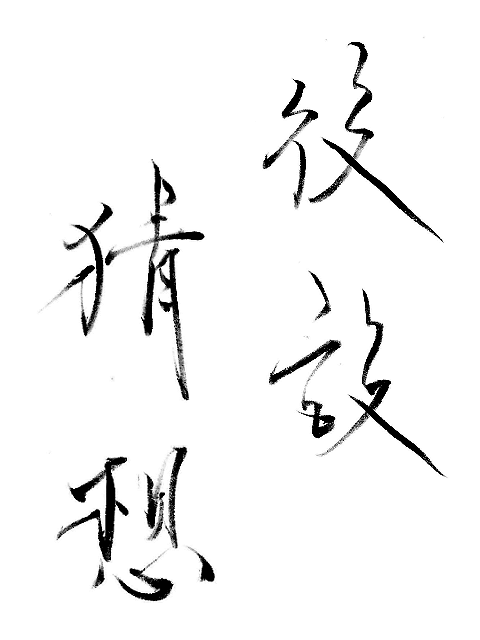
Chinese: 吳爾軒的後設猜想
English: Narvis the Cloud's Metahypotheses
Japanese: ナルビスのメタ予想
Latin: Narvis Nubes Metahypotheses

本網站內容之使用,請參閱著作權聲明書。
To use the contents on this website, please read Copyright Statement.

2015-11-22

何謂如來?
What is Tathagata?


如來,是佛的十大稱號的第一個稱號。 Tathagata, which means "thus having come" is the first one of Buddha's ten characteristics.
如來,顧名思義,就是「好像來了」,以量子力學的觀點而言,就是「處於來與不來的疊加狀態」。 Tathagata, as implied by the name "thus having come", means "as having come". In the aspect of quantum mechanics, it means "in a state being the superposition of having come and having not come".
《金剛經》云:「如來者,無所從來,亦無所去,故名如來。」來或不來、去或不去, 只是波函數的崩塌狀態,無法描述事物的全貌,它們有所偏狹,而不究竟圓滿,故如來非是。 Diamond Sutra says that, "Tathagata is neither having come from anywhere, nor having gone to anywhere, so it is called Tathagata." Having come, having not come, having gone or having not gone is only a collapsed state of a wavefunction. By only one of them, we cannot describe a full view of a thing. They are partial, but perfect, so Tathagata means none of them.
《金剛經》又云:「如來者,即諸法如義。」諸法如義,就是「各種性質都依循佛法」,而佛法是究竟圓滿的,它涵蓋了各種可能性。因此,如來就是「處於各種性質都處於各種可能性的疊加狀態的狀態」。 Diamond Sutra also says that, "Tathagata means in which all ways are such." Here, "all ways are such" means "all properties follow Buddhism". Since Buddhism is perfect, it covers all possibilities. Therefore, Tathagata means "in a state in which all properties are in a state being the superposition of all possibilities".
如來之定義,以符號表示如次:
∃T⇔(∃P⇔∃∪Pi∀i)∀P
其中,T為如來,P為特定性質,Pi為特定狀態,i為特定狀態編號。
The definition of Tathagata is symbolically expressed as follows:
∃T⇔(∃P⇔∃∪Pi∀i)∀P
Wherein T means Tathagata, P means a property, Pi means a state, and i means a state number.

有條件票票等值
Conditionally Equal Suffrage


慎思明辨之人,與道聽塗說、盲從迷信、貪財好賄之人,自不應票票等值,否則智痴相抵,不進反退。 A considerate person shall not have a voting right equal to that of a rumor believer, a blind follower, or a bribe acceptor, otherwise, the ignorance may cancel out the knowledge, and the society may backslide.
然我憲政至今,民智漸開,為立基多元,冀求方向,斯時票票等值,則有實益。 However, since we have carried out a constitutional country, up to now, the citizen's knowledge keeps raising, then it is beneficial for us to have equal suffrage, for realizing a multicultural future.

2015-11-15

1-2-5 意志
Will


回到目錄《後設猜想篇章節》。 Back to the menu, The Table of Content of The Metahypotheses.
第1篇第2章第5節 Volume.1, Chapter.2, Section.5
現象⊃個體⊃意志 Phenomena⊃Individual⊃Will
§ 1
意志,係自我之退化。 A will is the degenerate case of a self.
§ 2
自我,因自回饋而在特定時空不能特定其變數者,在該時空中無意志能力。 A self of which the variables cannot be certain at a certain spacetime due to its self-feedback lacks a will ability at said spacetime.
§ 3
意志之定義域及值域,時變或空變。 The domain and the range of a will are time-variant or space-variant.
§ 4 意志,其定義域或值域受羈束者,其意志力不完全自由;其等之一受羈束成一點者,其意志力完全不自由。 For a will of which the domain or the range is limited, its will effect is not completely free; for that of which one of them is limited to a point, its will effect is completely not free.
§ 5
自我,有下列情形之一者,無自由意志:
  1. 無意志能力。
  2. 意志力完全不自由。
  3. 意志之定義域或值域不由宇宙亂數器間接提供。
A self lacks a free will in one of the following conditions:
  1. It lacks a will ability.
  2. Its will effect is completely not free.
  3. The domain or the range of its will is not indirectly provided by the universal randomizer.
§ 6 I 意志之結果,不表示於世界者,不存在於世界。 A result of a will not expressed to the world is non-existent in the world.

II 意志之結果,至自我消滅時仍不及表示於世界者,即生世界上不存在性確定力。 A result of a will not expressed to the world even until the self's vanishment results in a prejudicial effect of its worldly non-existence.

2015-11-02

1-2-4 自我
Self


回到目錄《後設猜想篇章節》。 Back to the menu, The Table of Content of The Metahypotheses.
第1篇第2章第4節 Volume.1, Chapter.2, Section.4
現象⊃個體⊃自我 Phenomena⊃Individual⊃Self
§ 1
自我,係特定時空區域之阿賴耶識。 A self is an alaya-vijnana in a certain spacetime region.
§ 2 I 自我之終點與其後繼自我之起點不連續。 It is discontinuous where is the self's terminal point and its successive self's starting point.

II 自我與個體在時空上未必具有相同起訖。 A self and an individual does not necessarily have same terminal point or starting point.
§ 3 I 超我,非由觀察自我與非自我之不連續性,不可存在。 The super-ego can be existent only by observing the discontinuity between the self and the non-self.

II 超我,因前項觀察而為後設;其更後設者,仍視為超我。 The super-ego is of meta due to the observation in the preceding paragraph; the super-ego of even more meta is still deemed the super-ego.

2015-10-31

1-2-3 阿賴耶識
Alaya-vijnana


回到目錄《後設猜想篇章節》。 Back to the menu, The Table of Content of The Metahypotheses.
第1篇第2章第3節 Volume.1, Chapter.2, Section.3
現象⊃個體⊃阿賴耶識 Phenomena⊃Individual⊃Alaya-vijnana
§ 1
阿賴耶識,係宇宙本徵函數之一部。 An alaya-vijnana is a part of the universal eigenfunction.
§ 2 I 個體觀察個體本徵函數值所得之資訊,儲存於阿賴耶識。 An alaya-vijnana saves the information derived from observing by an individual the values of an individual eigenfunction.

II 前項儲存,係透過疊代改變宇宙本徵函數用以定義阿賴耶識之若干特定節點值,而重新定義阿賴耶識。 The save in the preceding paragraph is to redefine the alaya-vijnana by changing the values of the universal eigenfunction's certain nodes used to define the alaya-vijnana through iteration.

III 不同阿賴耶識,可儲存相同資訊。 Different alaya-vijnanas can save same information.
§ 3 I 阿賴耶識之初始條件,屬於不可觀察宇宙。 The initial conditions of an alaya-vijnana belongs to the unobservable universe.

II 除寂滅者外,阿賴耶識,時變或空變,直至非時變且非空變。 An alaya-vijnana is time-variant or space-variant until it is time-invariant and space-invariant, except for those of nirvanic ones.
§ 4 I 阿賴耶識,於非時變且非空變時,成為大圓鏡智。 An alaya-vijnana becomes the great perfect mirror wisdom when it is time-invariant and space-invariant

II 大圓鏡智,具有唯一性。 The great perfect mirror wisdom is unique.

2015-09-13

人格動態性
The Personality Dynamics


原則為人格之一部,故無原則者,其人格不能認存在。惟原則如附具相當理由,非不能時變或空變,〈原則之定義〉所謂:「隨時空之原則變化,以對上開變化亦存在原則為限,始無指摘之餘地。」旨趣在此。上開相當理由,實則後設原則也。 Principles are a part of personality, so one lacking principles cannot be deemed with personality. However, principles can still be time-variant or space-variant with reasonable reasons. This is what I have said in the Definition of Principle: "a temporary or spatial principle variation is not blamable, only if there is still a principle for said variation." Said reasonable reasons are actually metaprinciples.
後設原則固能支持原則變化,但滿足羅素悖論之原則應排除於後設原則之集合,要屬當然。 Metaprinciples can support principle variation, but principles satisfying Russell paradox shall be excluded from the collection of metaprinciples, of course.

2015-09-02

文明國家之四大原則
The Four Principles of Civilized Country


文明國家,以自由、民生、民主、法治為四大原則,而以自由為終極的依歸,至於民生、民主、法治,都是為了自由而存在。 A civilized country has four principles, liberty, welfare, democracy and constitution. Liberty is our ultimate target, while welfare, democracy and constitution are all for liberty.
我們追求自由,但若沒有民生,則生活勞苦,何來自由呢? We pursue liberty, but without welfare, lives will be poverty, not to mention liberty.
若沒有民主,則資源壟斷,何來民生呢? Without democracy, resources will be monopolized, not to mention welfare.
若沒有法治,則人情牽拖,何來民主呢? Without constitution, treatments will be unfair, not to mention democracy.
透過以上的反詰,我們了解:為了自由,才需要民生;為了民生,才需要民主;為了民主,才需要法治。四大原則有因果關係。 Thus, we conclude by contradiction that, we need welfare for liberty; we need democracy for welfare; we need constitution for democracy. There are relations among the four principles.
然而,為了法治,不免犧牲極小部分的自由、民生、民主,但完全犧牲,就本末倒置了。 However, we cannot avoid sacrificing a little liberty, welfare and democracy for constitution, but it is wrong to sacrifice all of them.
為了民主,不免犧牲極小部分的自由、民生,但完全犧牲,就本末倒置了。 We cannot avoid sacrificing a little liberty and welfare for democracy, but it is wrong to sacrifice all of them.
為了民生,不免犧牲極小部分的自由,但完全犧牲,就本末倒置了。 We cannot avoid sacrificing a little liberty for welfare, but it is wrong to sacrifice all of it.
四大原則,有其順序,不容顛倒錯亂。 The four principles is ordered shall be ordered in this way.